
The Intention Behind the Intention: JB's Monday Momentum #39
On thoughts, attention, and the life they shape

Estimated reading time: seven minutes
Welcome to Monday Momentum, the weekly newsletter where I discuss practical wisdom, uncovering insights to enhance our lives one thoughtful moment at a time. While I have confidence in the ideas I write about, I am still learning them. I acknowledge that what works for me may not work for everyone. Take each idea as you see fit and let me know what you think!
Hello friend,
It has been about six months since I last published a letter. Around the same time, I chose three words to orient myself for the year: energy, patience, and intention. Now, almost halfway through the year, one has clearly stuck out more than the others. Intention. The way we direct it shapes how we think, how we act, and ultimately the kind of life we build.
If you missed the last edition—“Childlike Living”—you can click here to check it out.
A Question I am Contemplating:
What does it mean to be intentional with your mind?
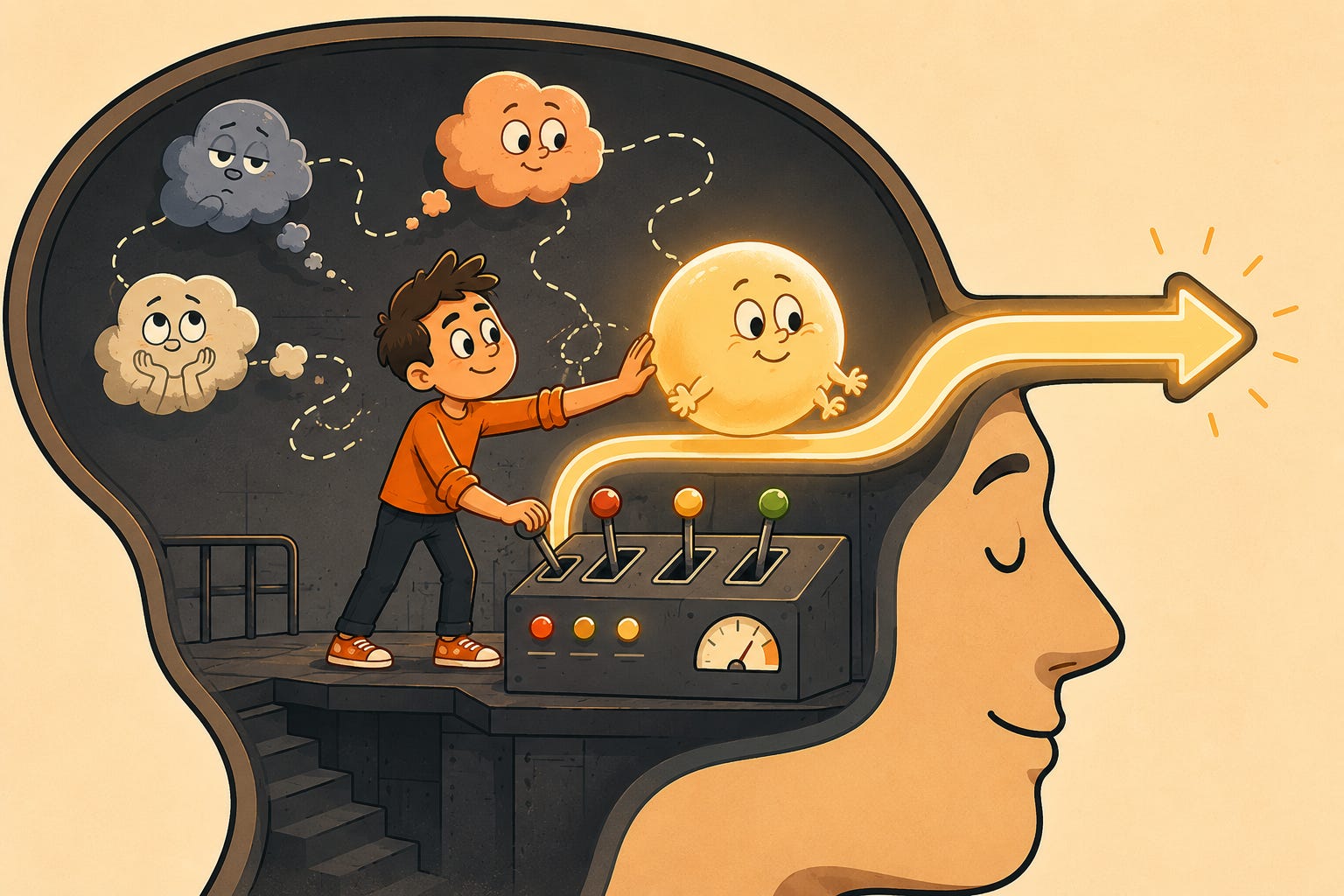
It is easy to live as though the inner life is something that happens to us. Thoughts arrive on their own, moods settle in without permission, and we move through the day shaped by whatever found us that morning. We treat the resulting experience as a fact about the world rather than a consequence of where our attention went. Most days, it goes unquestioned. But beneath that ordinariness is something we rarely stop to notice. We are not merely receiving our inner lives. We are authoring them, continuously, whether or not we are paying attention to the writing.
What I find notable about this is how rarely it shows up in the way we talk about ourselves. We say that we had a good day, that we were in a mood, that something made us anxious or content, as though these were forces acting on us from outside. Some of that is true. Things happen, and we do not get to choose what comes. That being said, there is a difference between what enters the mind and what we let stay there; the thought that surfaces is not the same as the thought that gets followed. Somewhere between the two, there is a choice.
To be intentional is to begin noticing where those choices live. Not to control everything that comes through the mind, which is neither possible nor desirable, but to pay close enough attention that we can tell the difference between a thought we have chosen and a thought that is just drifting. Without that attention, the “drift” will become your life.
I have noticed this most clearly in moments where something outside my control has gone in a direction I did not want. A conversation that did not land the way I hoped. A result that did not arrive in the way I expected. A class or piece of work that has not been what I imagined it would be. A relationship that has not turned out the way I thought it would. In those moments, the situation itself is finished. Whatever happened has already happened. What remains is entirely internal and entirely mine. If I am not paying attention, the underlying emotion takes the wheel, and I find myself somewhere I did not choose to be because I let the response unfold without ever stepping in. If I am paying attention, something else becomes possible. I can decide what I want to make of what happened. If I want to feel X, I have to believe in X. If I want to feel Y (even if Y is negative1), I have to believe in Y. Either way, the response is mine. What happens to you is not yours to choose. What you do with it always is.2
The first step in nearly anything worth wanting is choosing it, not as a wish but more as a direction, because without that initial choice, the rest of the work has nothing to build on. However, there is even a step before that. Before intention can do anything, you have to decide that the inner life is worth attending to at all; you have to be intentional about being intentional. Most of us never quite make that decision. We assume the mind will sort itself out, or that the conditions of our lives will eventually become favorable enough that we will not need to think about any of this. But the mind does not sort itself out. It tends toward whatever it finds, and what it finds is not always what serves us. The decision to pay attention is not one you make once. It is one you have to keep making, usually before the day has given you any reason to.
I should be careful, though, not to suggest that every moment should be directed. There is something real and worth protecting about the unintentional. The wandering thought that arrives somewhere you did not know you were looking for. The conversation that drifts unexpectedly. The walk that takes too long because your dog won’t turn around and ends up just walking you. You think you are going around the block, and then she finds a smell she likes, and then she sits down, and then you are out there for forty minutes with no real plan, and then you’re late for whatever plans you had. Oh, sorry, got a bit sidetracked. But back to what I was saying. Some of what we know about ourselves we only learn by letting the mind go where it wants. To live under constant supervision, watching every thought before it is even felt, is not intention. It is something closer to fear.
The distinction is between intention as a direction and intention as a “cage”. A direction sets a course but leaves room for the unexpected. The mind can wander, and you let it, because you know where you are. A cage tries to control every step, and the mind eventually pushes back against it. The point is not to never wander. The point is to know when you are wandering. Drift, by contrast, is the wandering you do not notice.
Once you start drawing that line, the whole thing starts to feel less like a discipline and more like a habit. You do not have to be “on guard” every minute of every day. You just have to know where you are in your own mind and trust yourself to recognize when you have drifted somewhere you did not mean to go.
I still catch myself halfway down a path I never meant to take, following a thought I would not have chosen if I had been paying attention. But the practice of intention is not something you arrive at. It is something you return to. The mind will wander, sometimes for good reason, and the work is in bringing yourself back when you notice you have gone. When you do, something begins to compound, and a cycle forms. Intentional thoughts lead to intentional actions. Those actions tend to be the ones you actually want to be doing. Doing them tends to make you feel better, which makes the next thought easier to direct. The cycle does not start in the action or the feeling. It starts in the thought. What you give your attention to is what your life becomes.
Quote on intention:
“The soul becomes dyed with the color of its thoughts.” — Marcus Aurelius
Goal for the Week:
Break the routine once a day
My days have started to blur together lately. Wake up, work, workout, cook, eat, watch an episode of Game of Thrones, sleep, repeat. This isn’t necessarily bad, it's just the same3. So this week the goal is to do one thing that isn't on the usual schedule. A walk somewhere new, time set aside to read or write, anything that interrupts the pattern a little.4
Secrets of Sand Hill Road — Scott Kupor
What I finished reading:
The Book of Elon — Eric Jorgenson
The whole book is built from Elon's own words, pulled from interviews, talks, and writing over the years, but Jorgenson arranges the fragments so well that it reads less like a collection and more like a long conversation with Elon about building, risk, and chasing something you actually believe in. Whatever you think of the man, you cannot deny that he has found a purpose and pursued it to the absolute maximum. There's something inspiring in that, and a lesson we could all take from it. When he started SpaceX, he believed he would lose everything, and he went all in anyway, putting his entire fortune and his life into advancing humanity toward Mars because he believed in it that cause deeply. The sections on what makes a great founder are excellent, the stories from his life are entertaining, and the whole thing gives you a look inside the head of one of the most influential people alive. Even if you don’t buy into his cause, there’s a lot to take from it. What he has to say about purpose, founding, and risk applies to anyone. I give The Book of Elon an 8.5 out of 10.
Favorite quote: “Go do it. Just go out there and do it. People are far too afraid to try. Fear is the biggest reason for failure. Don’t be afraid to fail. Just go. If you don’t push for radical breakthroughs, you’re not going to get radical outcomes.”5
What I’m listening to (one podcast, one artist, one song):
The Tim Ferriss Show: The Return of The Lion Tracker — Boyd Varty on The Wild Man Within, Nature’s Hidden Wisdom, and How to Feel Fully Alive (#832)6
CBDB
“Up All Night” — Widespread Panic
Thanks for reading! Don't forget to subscribe to stay updated for the next edition and feel free to leave a comment. I'd love to hear your thoughts.
Take care,
James
Negative does not mean bad. Some of the most important things I have learned came from sitting in the emotions I would not have chosen, and being intentional includes letting yourself have those.
This is more or less Epictetus's whole philosophy, and a backbone Stoicism: "Men are disturbed not by things, but by the views which they take of things." Naval Ravikant has similar thoughts about happiness. He essentially says happiness is less something that happens to you and more something you choose and practice. Same sentiment … a couple thousand years apart.
I strongly believe we should seek more novelty; part of my reasoning for this goal stems from that belief. I also think this would make each day more interesting and give you an extra thing to look forward to. Who doesn’t want that?
Then again, a little more intention up front and this probably fixes itself
A close second: “We must be optimistic. There’s no point in being pessimistic. It just doesn’t help. My theory is you’d rather be optimistic and wrong about the future than pessimistic and right. If you’re pessimistic, you’re going to be miserable. Might as well enjoy the journey.”
The storytelling and the way Varty is able to turn those stories into real insight is unbelievable and very entertaining. Their first episode together was also very good. Would definitely recommend checking that one out as well.